How automated AI sports commentary works
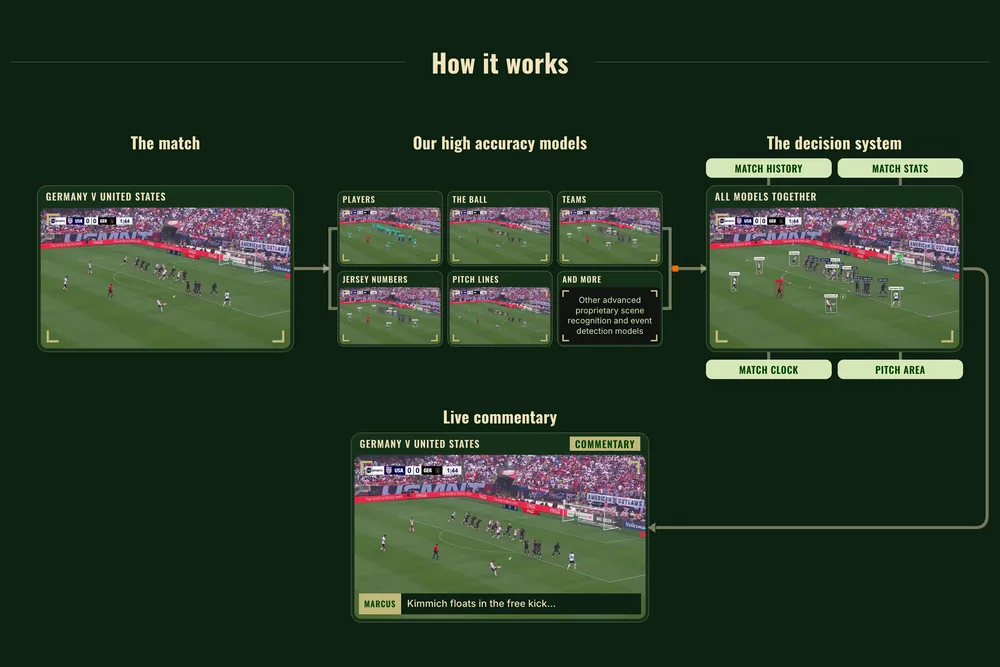
Automated sports commentary is commentary that software produces from a match, with nobody on the microphone. Every system that does it has to answer the same question first: what does the software start from? Some start from a feed of match data. Liat.ai starts from the match video, and it does this for football.
Two ways to automate commentary
The first way starts from event data. People or tracking systems log every pass, shot and foul, and a language model turns that log into sentences. The Bundesliga works this way. With AWS and Sportec Solutions, it built a live text commentary that writes about each match event in several languages and styles, from about 1,600 data points a game. WSC Sport uses game event data to write the script for a recap video, then gives it a synthetic voice. That system runs in the NBA app in Spanish, French and Portuguese.
The second way starts from the video. The software watches the match, works out what happened, and then commentates on it. IBM has taken this route in tennis, with AI commentary at Wimbledon and the US Open. Its principal scientist says the aim is to "provide more coverage for courts that currently lack commentary".
Event data is precise, but it is expensive, and data providers mostly cover the top leagues. Below the top tiers, most matches have no data feed at all, so they get nothing from commentary built on one. Every match that is streamed has a video. That is why Liat.ai starts from the video, and why one camera at the ground is enough for it to work.
A 2025 survey of AI-generated game commentary sorts what a commentator needs into three abilities: watching the match live, analysing the play, and recalling the history around it.
Step 1: watching the match
Liat.ai uses advanced proprietary models to watch the match video. Detection and tracking models find every entity on the pitch, including each player, the referee and the ball, and follow each one from frame to frame. Another model assigns every player to a team from the colour of the kit.
High accuracy optical character recognition (OCR) models read the number on each player's jersey. That is how Liat.ai puts a name to the player on the ball.
Liat.ai also finds the exact lines of the pitch. A camera sees the pitch at an angle, and the lines let Liat.ai map every position on the screen to a position on the pitch. That is how it knows a shot came from inside the penalty area and not from just outside it. The positions of the players relative to each other are also what Liat.ai uses for its tactical insights.
Step 2: recognising events
Liat.ai has its own event recognition models. They work in real time and understand each scene as it happens. Together they detect more than thirty types of event as the match is played, including goals, shots, headers, crosses, passes, dribbles, fouls, cards, corners and substitutions.
Liat.ai then combines these events with the output of all its other models to build an understanding of the whole match: who has the ball, where they are, what came before and what it means for the score.
Each event is tied to the player who made it and to where it happened: which third of the pitch, which side, and whether it was inside the penalty area. Liat.ai also keeps a record of the passes before each moment, so the commentary can say how a goal was built.
Liat.ai also analyses the formations, the interesting plays and how the game changes from minute to minute. It can see a low block forming, a forward running in behind the last defender, or more attackers breaking forward than the defence has back. The technology page shows each of these on a real match.
Step 3: deciding what to say
A good commentator chooses which moments to talk about. Liat.ai has a decision system that does the same job. It takes the events, the match clock, the score, the statistics and the story of the match so far, and decides which moments deserve a line and how big each line should be.
This is also where the commentary takes on the style you set. You can make it neutral or biased to either team, have it follow one player, or have it follow your own style guide. In the quieter spells, it can bring in the records of the two teams and the careers of the players, if you give it that data or it is available online (optional).
Step 4: speaking the commentary
Liat.ai then writes the commentary and speaks it with minimal latency. It writes the commentary in each language directly, so a Spanish feed is written in Spanish from the start. It can commentate in 20+ languages, and the voice changes with the region a language is spoken in, such as Spanish (Spain) or Spanish (LatAm).
The commentary rises with the size of the moment, and you choose how excited the commentator gets. Our two English commentators show the range. Marcus is the excited voice and does the play-by-play. Gary is the calm voice and does the colour commentary. You can hear both on the commentary page.
You can take the commentary back in three ways: the finished stream with the commentary already on your video, the audio on its own for you to mix, or each audio clip on its own, timestamped, as the event is detected.
When the system is not sure
An important event is checked before the commentary names it. Multiple models have to agree. If you send a live data feed, Liat.ai also uses it to confirm events (optional). When it cannot be sure, the commentary says so out loud, as a commentator would: "That could be a foul."
If your broadcast can allow a few seconds of delay, Liat.ai sees what comes next before it speaks. We call this delayed live. When a shot becomes a goal, a short line on the shot leads straight into the goal.
What automated commentary is used for
- Matches that are streamed with no commentary at all, from lower leagues to youth academies.
- More languages on matches that already have a commentator, with each feed in its own language.
- Separate home and away feeds from the same match, each biased to its own team.
- Recordings of past matches, commentated after the final whistle.
- Highlight videos with commentary on them, made automatically from the same match.
Common questions
Does automated commentary need a data feed? Systems built on event data do. Liat.ai needs only the match video. A data feed can help confirm events (optional).
Is it live? Liat.ai commentates live, with minimal latency. It can also commentate on a recording after the match.
Which sports does Liat.ai cover? Liat.ai commentates on football.
How much does it cost? Commentary on Liat.ai starts from about $3 a match.
You can watch Liat.ai commentate on the demo page and see what its models detect on the technology page. If you stream grassroots football, our guide to adding live AI commentary walks through the setup. The FAQ answers the common questions about cameras and setup.